China Battery Makers Lead Clean Energy Stock Surge


When oil prices rise due to geopolitical crises, the usual expectation is that energy companies benefit and everything else suffers. What happened after conflict escalated in the Middle East in late February told a very different story. As crude oil prices climbed, it was Chinese battery manufacturers, not oil majors, that saw the most dramatic gains in market value. For anyone tracking clean energy stocks or trying to understand where long-term investment is flowing, the signals are worth examining closely.
A $70 billion market shift after the Iran shock
According to a Financial Times report, three major Chinese energy companies saw their combined market value rise by $70 billion in the wake of the attacks. Contemporary Amperex Technology Co. Limited (CATL), the world's largest battery manufacturer, rose by 19%. Sungrow, a leading supplier of solar inverters and energy storage systems, rose by 19.4%. BYD, China's largest electric vehicle and battery producer, rose by 21.9%.
Compare that to the oil majors. BP rose 15.2%, Shell rose 8.3%, Chevron rose 8%, and ExxonMobil rose 4.7%. This happened even as oil prices themselves rose by 47%.
The conventional logic would suggest that higher oil prices benefit oil companies most. The fact that battery makers outperformed them by such a wide margin suggests that markets were thinking about something bigger than short-term price movements. Investors were not just reacting to a supply shock. They were pricing in the long-term cost of depending on imported fossil fuels in an increasingly unstable world.
How the China energy storage market turns energy security into demand
Energy security is the key to understanding this shift. Reuters reported that investors increasingly expect oil-importing economies to respond to instability in the Middle East by accelerating investment in renewable energy, stronger power grids, and greater storage capacity. The International Energy Agency (IEA) offers a clear explanation of why. Batteries used in both vehicles and large-scale stationary storage systems reduce an economy's dependence on imported fossil fuels. When combined with renewable generation from solar and wind, they also reduce the need for gas- and coal-fired power plants. In that context, the rise in clean energy stocks is less a reaction to a news event and more a reflection of structural, long-term demand.
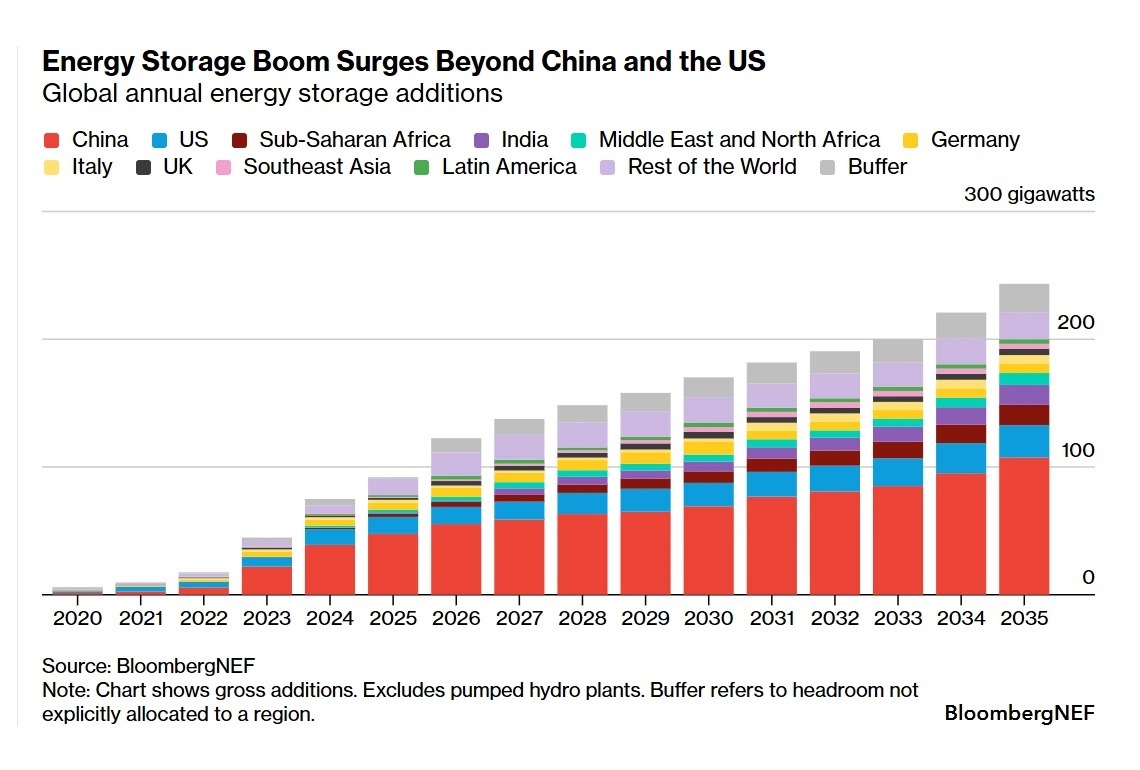
The scale of what is being built in China reinforces this. According to BloombergNEF, the amount of new energy storage capacity China adds each year is projected to increase approximately 20-fold between 2020 and 2035. That growth is not driven by sentiment alone. Grid-scale batteries, meaning large battery installations connected directly to the electricity network, serve practical functions that have nothing to do with electric vehicles. They help stabilise grid frequency, smooth out the natural variability of solar and wind generation, manage peak demand, and make power dispatch more efficient. For any country worried about the reliability of fuel imports, a grid with built-in resilience becomes a strategic priority.
Why China battery makers are being valued like infrastructure companies
This is where the business model insight becomes important. Batteries are a practical solution to two separate problems at once: the environmental cost of burning fossil fuels and the financial and political risk of depending on them. That dual value proposition is part of why investors are beginning to treat China battery makers less like cyclical manufacturers, whose fortunes rise and fall with economic cycles, and more like infrastructure builders whose products underpin an entirely new kind of energy system.
China's position in that system is substantial. The IEA reported that China invested more than $625 billion in clean energy in 2024 and reached its targets for wind and solar capacity six years ahead of schedule. That scale of investment helps explain why the China energy storage market is now drawing serious interest from utilities, large industrial users, and the data centre industry, all of which need reliable, flexible power at scale.
What this means for investors and industry observers
The broader lesson here is one about timing and attention. Some of the clearest investment opportunities emerge when a geopolitical event exposes an old vulnerability and a maturing technology offers a credible solution to it. The Iran shock did not create the case for energy storage. It made it more visible and more urgent. For founders, operators, analysts, and investors, the question worth sitting with is this: when an industry's economics shift in response to new realities, how quickly do you notice?
FAQs
Got A Question?
Everything you need to know about impact careers, sustainable job opportunities and our talent network in one easy place.
Our House Views content library and Awareness to Action series share insights on sectors, roles and career moves. Many candidates use these resources to narrow their focus before speaking with us.
Because the numbers are clear. Green and transition sectors are growing faster than the rest of the economy, attracting capital, talent and innovation. Positioning yourself there is a commercial decision, not just a values one.
Awareness to Action is our interview and insight series. We speak with leaders across the impact economy and turn real conversations into practical guidance for careers, teams and capital.
Yes, we regularly feature impact investors, founders and sustainability leaders in interviews and House Views content. If you have something valuable to share with the impact economy, we would love to hear from you.