Growth vs Environment: A False Trade-Off
One of the biggest challenges facing the environmental movement was the perceived trade-off between ecological responsibility and economic growth. People agreed in principle that the environment mattered and that climate change was an issue. Where problems arose was when action appeared to require an economic sacrifice.
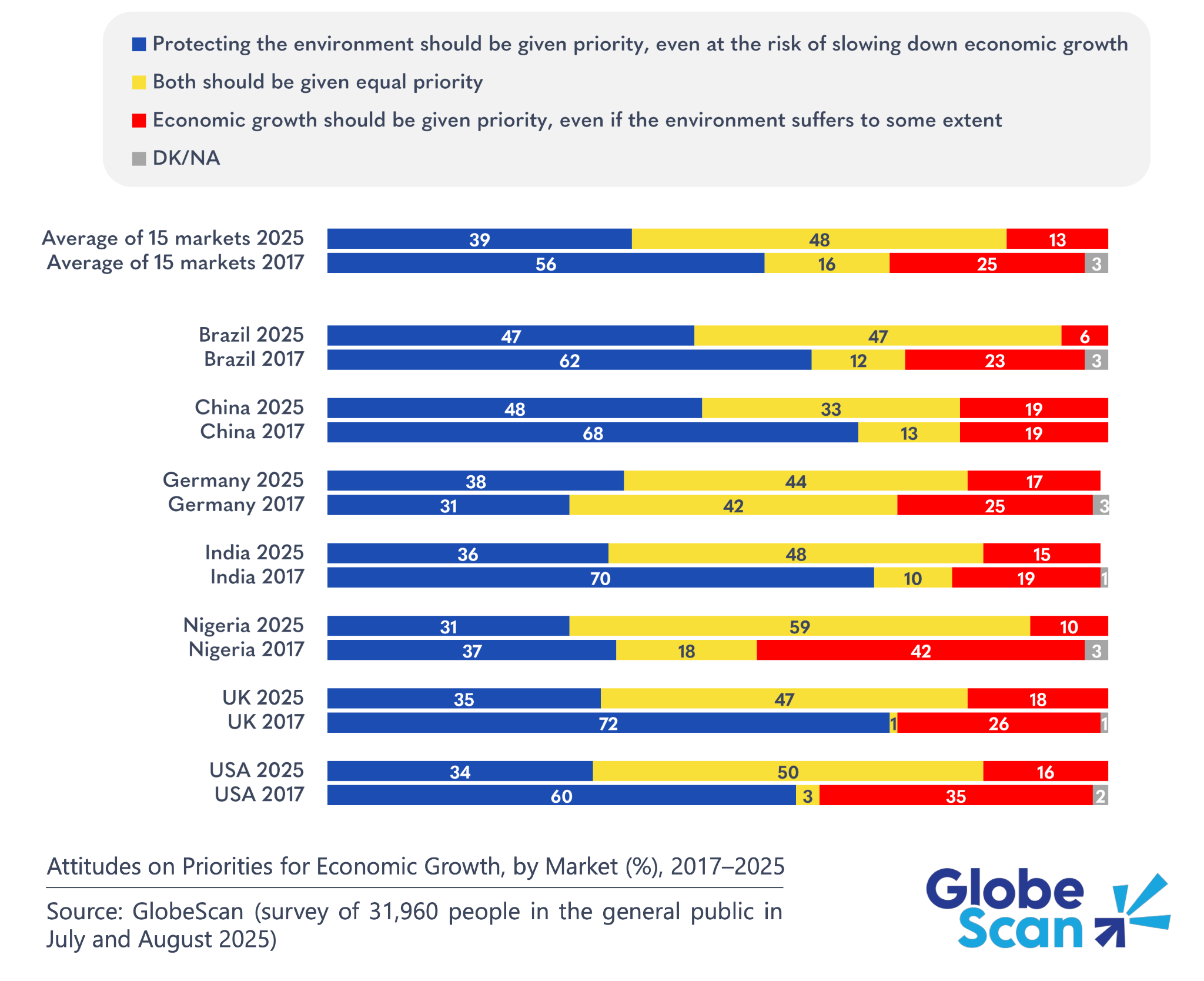
However, that fundamental assumption is now shifting. Across 15 major markets, only 13% of people believe economic growth should take priority even if the environment suffers. Nearly half believe both deserve equal priority, and 39% believe environmental protection should come first even at the risk of slower growth. The idea of growth at all costs has never had less public support.
Such a major shift gives governments and organisations more room to pursue sustainability, resilience, and long-term value creation, knowing that the public backs the move.
The shift in public thinking
Over the last five to ten years, the gap between environmental warnings and lived experience has closed. Economic growth has slowed, the consequences of environmental destruction have become harder to ignore, and younger generations are taking the reins.
Due to economic shocks from Covid-19, the Russia-Ukraine war, and now the US-Israeli conflict with Iran, economic pressures have brought growth back to the top of public concern. However, at a time when political rhetoric might suggest the public no longer cares about environmental protection, the data tells a more nuanced story. The share prioritising environment over growth has fallen, but the constituency who either prioritise the environment or want it treated equally with economic growth has risen across most markets surveyed.
The problem for organisations
Sustainability is still treated as a cost centre in many organisations, something that impedes growth rather than enabling it. This belief rarely appears in policy documents or meeting agendas, but in practice it shows up in how sustainability is resourced, measured, and prioritised. It becomes a compliance function or a marketing layer rather than a strategic one.
Organisations tend to fall into one of two patterns:
- “Growth First” operators focus purely on commercial performance and treat sustainability as a distraction, leaving them exposed to cost volatility, regulatory pressure, and reputational risk as conditions change.
- “Sustainability First” operators treat sustainability as a separate initiative, which often limits commercial integration and constrains how far it can scale.
Neither position fully captures the opportunity. As energy prices remain volatile and supply chain reliability comes under pressure, renewable and sustainable options are increasingly making commercial sense on their own terms. Combined with falling technology costs, the economic case for sustainable solutions is strengthening, not weakening.
What moving forward looks like
If the perceived trade-off between growth and sustainability no longer holds, the question becomes practical: what do organisations actually do differently?
The first step is to stop treating sustainability as a parallel track. Every discussion about shelf space, consumer demand, cost savings, efficiency, and growth should have sustainability principals built in, not added on afterwards.
That begins at the leadership level. Senior leaders need to make decisions that tie sustainability directly to performance, investing in more resilient energy systems, reworking supplier contracts to reduce exposure, or accepting short-term cost increases to avoid long-term volatility.
At a practical level, operations teams will be critical. They are the ones redesigning supply chains, sourcing lower-risk inputs, and figuring out how to maintain reliability as conditions become less predictable. They will work with finance teams to factor in energy prices and resource constraints, and with product teams to prioritise durability and efficiency as a way to protect long-term value.
Execution is what matters now
The argument for treating sustainability and growth as opposing forces has always been weak. The data, the economics, and the direction of public opinion all point the same way. What is lagging is execution.
The organisations that close that gap will do so by having the right people in place: leaders who can make commercial decisions with sustainability built in, operators who can redesign systems under real constraints, and advisors who can translate the strategic case into operational reality.
The question is not whether your organisation has a sustainability strategy. It is whether you have the people to deliver a business model that means you don't need one.
FAQs
Got A Question?
Everything you need to know about impact careers, sustainable job opportunities and our talent network in one easy place.
Our House Views content library and Awareness to Action series share insights on sectors, roles and career moves. Many candidates use these resources to narrow their focus before speaking with us.
Because the numbers are clear. Green and transition sectors are growing faster than the rest of the economy, attracting capital, talent and innovation. Positioning yourself there is a commercial decision, not just a values one.
Awareness to Action is our interview and insight series. We speak with leaders across the impact economy and turn real conversations into practical guidance for careers, teams and capital.
Yes, we regularly feature impact investors, founders and sustainability leaders in interviews and House Views content. If you have something valuable to share with the impact economy, we would love to hear from you.