Decarbonisation Looks Different for Every Organisation

In 2015, 195 countries signed the Paris Agreement: a legally binding treaty to keep "global average temperature to well below 2°C above pre-industrial levels" and pursue efforts "to limit the temperature increase to 1.5°C above pre-industrial levels". The UN's Intergovernmental Panel on Climate Change (IPCC) states that limiting warming to 1.5°C required "global greenhouse gas emissions to peak before 2025 at the latest, and be reduced by 43% by 2030". Although exceeding 1.5°C is now widely considered as unavoidable, immediately reducing emissions is imperative to ensure we return to below the threshold by the end of the century.
According to Carbon Brief, in 2025, 86.2% of the worlds primary energy consumption came from fossil fuels. In the UK, in 2025, 75.1% of primary energy consumption came from fossil fuels This leaves the heavily fossil fuel dependent world a lot of work to do to reach net zero.
Although those numbers might seem intimidating, they represent significant opportunity for industry, paving the way for extensive development and an increasing demand for capable talent. Every industry, organisation and individuals carbon footprint is different, and the systems these entities operate within and how they transcend different boundaries varies massively. Therefore, there are a multitude of different strategies and approaches to addressing decarbonisation.
Consider Glastonbury festival, LEGO, and touring musicians such as Coldplay and Billie Eilish. All have taken steps towards decarbonisation. Decarbonising a music festival, however, looks very different from decarbonising a multinational toy company or a global concert tour.
Progress will depend on individuals who are systemic thinkers, and have the commercial expertise to scale the technological developments and business models needed to reach net zero in time to ensure we return to below the 1.5°C threshold by the end of the century.
Glastonbury Rebuilt the Infrastructure Behind a Temporary City
Glastonbury Festival takes place on Worthy Farm in Somerset, and its licence allows up to 210,000 people on site, including fans, staff and performers. For five days, around 1,000 acres of farmland become a temporary city with its own power, catering, sanitation, transport and waste systems. When the festival ends, all of it comes down again.
That set-up creates two big sources of emissions. The first is power. Running stages, kitchens and lighting across open fields has traditionally meant relying on diesel generators. The second is travel. A study by A Greener Future, a sustainability certification body for events, found that audience travel makes up around 41% of an average festival's carbon footprint.
Glastonbury has made the most progress on power. In 2025, the festival reported that no fossil fuels were used for power anywhere on site. All generators ran on hydrotreated vegetable oil (HVO) made from waste cooking oil, with no virgin palm oil. The festival says this cuts the generators' carbon dioxide equivalent emissions by up to 90% compared with fossil diesel. Its own solar array and biogas plant power the festival offices and some production areas. A temporary wind turbine with solar panels and batteries powers the food stalls in Carhenge.
On travel, the festival says more than a third of ticket-holders arrive by bike or public transport. National Express runs coaches from more than 90 locations, and cyclists get their own campsite. The festival has also banned single-use plastic drinks bottles since 2019.
There's reason to treat the headline figure with some caution. The 90% reduction applies to the fuel, not the festival's whole footprint. Power is also the part of the footprint Glastonbury controls most directly. Travel is the larger share, and it depends on choices made by hundreds of thousands of people.
LEGO Is Redesigning the Materials Behind Its Bricks
The LEGO Group is the Danish toy company behind the LEGO brick. Almost all of its emissions come from outside its own factories. In 2025, 99% of the company's greenhouse gas emissions came from its supply chain, and that includes the raw materials its bricks are made from. Those materials have historically been plastics made from virgin fossil fuels. Any replacement has to be as durable and safe as the original, and it has to fit bricks made decades ago.
LEGO has committed to cutting its absolute emissions to 37% below 2019 levels by 2032. In 2025, revenue grew 12% while total emissions stayed flat at 2.19 million tonnes of carbon dioxide equivalent, so the company grew without adding to its footprint. In 2023, the company dropped plans to make bricks from recycled plastic bottles after finding the switch wouldn't reduce its emissions.
LEGO's main approach is to change what goes into the plastic. In 2025, 52% of the materials LEGO bought came from recycled and renewable sources, up from 33% the year before. Most of that share is counted through a mass balance system. LEGO's suppliers mix certified renewable ingredients with fossil ones during production, then assign the renewable portion to LEGO on paper, much like a green electricity tariff. The company has tested more than 600 alternative materials and already makes flexible pieces from plastic derived from sugarcane.
LEGO is also extending the life of bricks already made. LEGO Replay collects unwanted bricks in the UK and passes them on to children through schools and charities.
These are early steps, and LEGO has a long way to go. Its absolute emissions haven't started to fall, and most of its renewable material is counted on paper through mass balance. The real test is whether total emissions start coming down before 2032.
Coldplay and Billie Eilish Are Changing How Tours Operate
A global tour involves flights, freight, venue power, catering and merchandise. Behind every headline act is a small industry of crew, suppliers and emissions. Touring artists can't stop travelling or performing, so they and their teams have to find ways to cut the impact of each show.
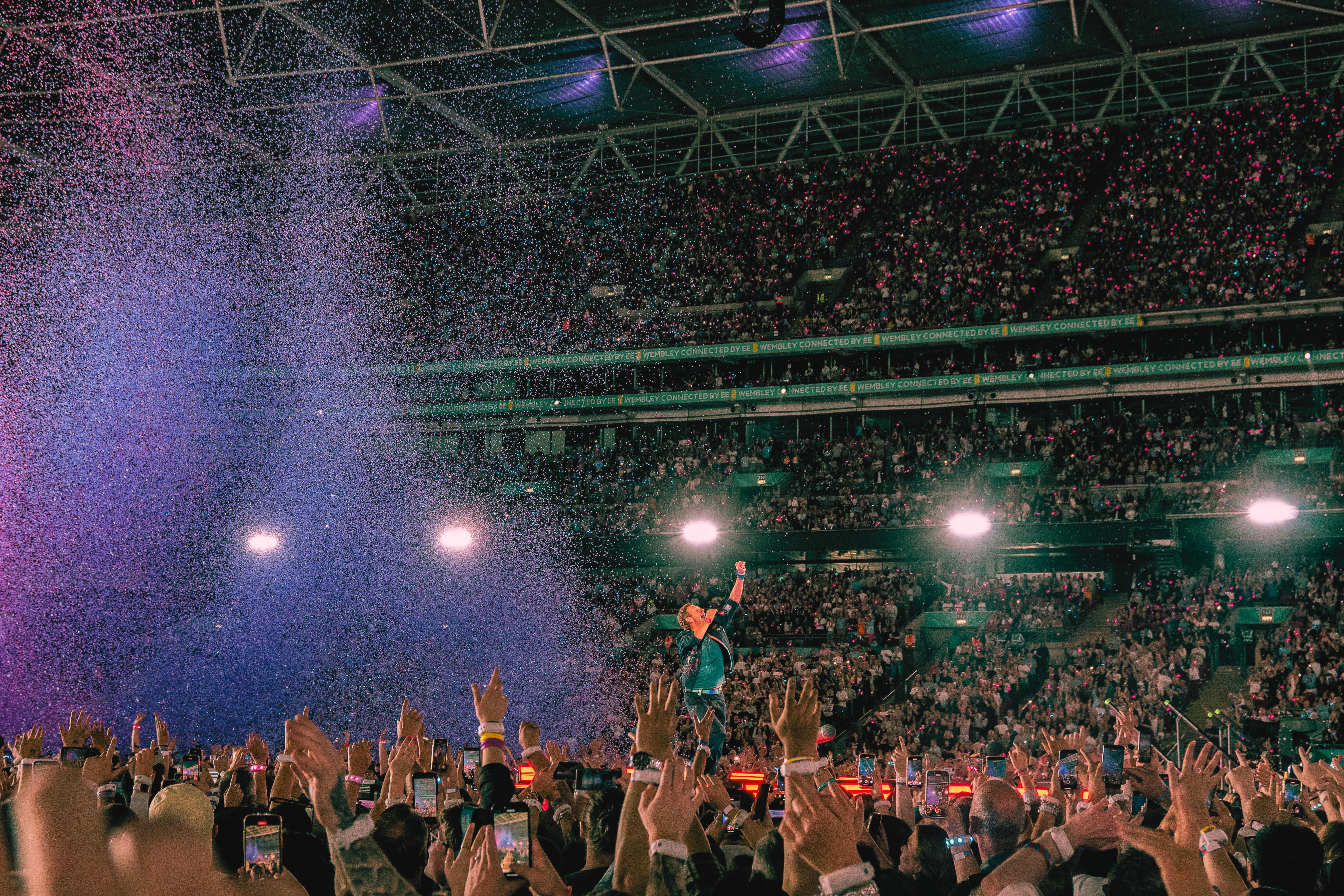
Coldplay reported a 59% reduction in direct carbon emissions per show during the first two years of its Music of the Spheres tour, compared with its 2016 to 2017 stadium tour. In 2023, 18 shows ran entirely on a touring battery system built from recycled BMW car batteries. Fans helped generate electricity on kinetic dance floors and power bikes inside the venue. The band cut its freight impacts by a third, and 86% of the light-emitting diode (LED) wristbands given to fans were returned and reused. A third of fans travelled to shows by public transport, and the average fan's travel footprint was 48% lower than on the previous tour.
Billie Eilish's work with REVERB and Support+Feed on her Hit Me Hard and Soft tour focused on everything surrounding the performance: what crew and fans eat and drink, and how they get to the show. REVERB is an environmental non-profit, and Support+Feed is a plant-based food charity. Plant-based meals were the default backstage, and hiring local caterers at each stop took a full bus and truck off the tour. Venues served drinks in their original containers, avoiding more than 1 million plastic cups. Refill stations helped fans and crew avoid 135,260 single-use bottles. In several cities, including every show in Australia, tickets came with free public transport. Each measure relied on catering, logistics and venue teams making it work night after night.
These are first steps. Reusable cups and bottles, plant-based catering, rescued food and lower-carbon travel all reduce a tour's impact. None of them yet solves the emissions that come from moving artists, crew, equipment and fans around the world. Billie Eilish's tour hasn't published an emissions figure, so there's no way to tell how much her measures cut its footprint. Coldplay's figure covers only the first two years of its tour. Large-scale touring is still a long way from net zero.
Decarbonisation Needs People Who Can Adapt and Scale New Ideas
When it comes to decarbonisation, every organisation starts with a different problem.
Glastonbury set out to run a five-day city for up to 210,000 people without fossil fuel power, and to get as many of them as possible there by coach, train or bike. LEGO has had to rethink the material at the heart of its product. Coldplay and Billie Eilish had to examine every lorry, meal, venue, wristband, and audience journey behind a night of music.
Decarbonisation looked radically different for each organisation, even if the end result is the same. Progress depends on people who can identify sources of emissions and devise solutions that don't impair performance.
LEGO without the brick wouldn't be LEGO. Glastonbury without its scale and spectacle wouldn't be Glastonbury. Global artists are going to tour the world. Most of the changes happened behind the scenes. On the surface, it's business as usual.
Decarbonising and reducing environmental impact look different for every organisation, because each one has a different core it can't give up. Reaching net zero will depend on multidisciplinary thinkers who understand that core well enough to change everything around it, and who can turn first steps into measurable cuts. That's where the opportunity sits.
FAQs
Got A Question?
Everything you need to know about impact careers, sustainable job opportunities and our talent network in one easy place.
Our House Views content library and Awareness to Action series share insights on sectors, roles and career moves. Many candidates use these resources to narrow their focus before speaking with us.
Because the numbers are clear. Green and transition sectors are growing faster than the rest of the economy, attracting capital, talent and innovation. Positioning yourself there is a commercial decision, not just a values one.
Awareness to Action is our interview and insight series. We speak with leaders across the impact economy and turn real conversations into practical guidance for careers, teams and capital.
Yes, we regularly feature impact investors, founders and sustainability leaders in interviews and House Views content. If you have something valuable to share with the impact economy, we would love to hear from you.