Planetary Health Check 2026: Seven Boundaries Breached
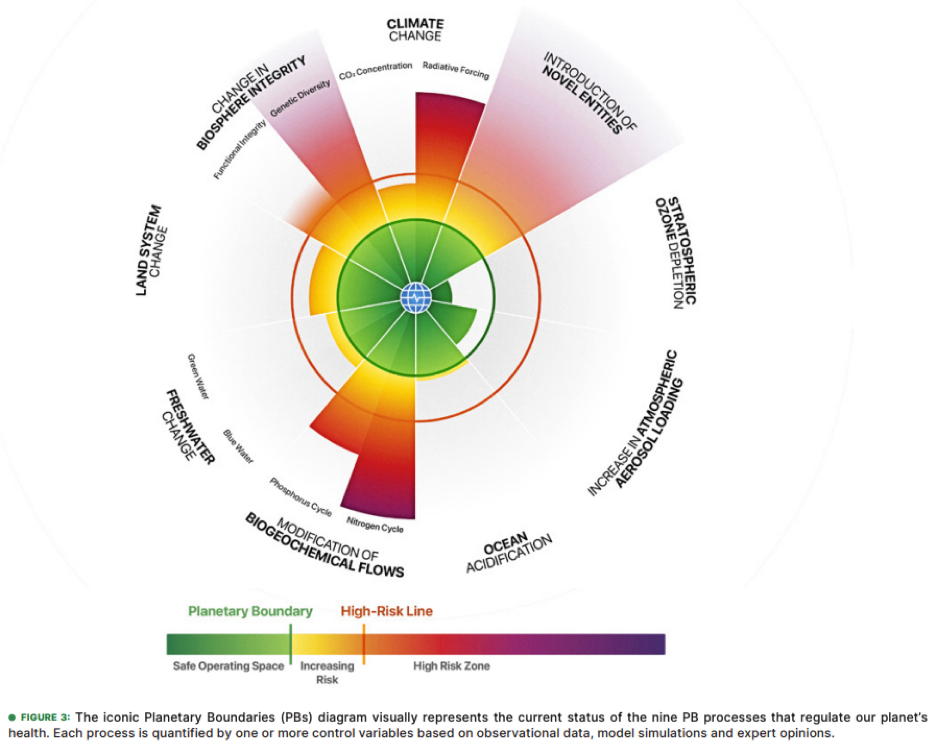
The Planetary Health Check monitors nine Earth-system processes considered critical to planetary stability and resilience. According to the 2026 report, seven out of nine are now outside the proposed safe operating space, and they’re moving in the wrong direction.
Seven planetary boundaries are now outside the safe operating space
The framework is relatively simple. Each year, more than sixty scientists at the Potsdam Institute for Climate Impact Research assess the nine Earth systems. Ensuring the stability of the Earth systems is essential to maintain a safe operating space for humanity.
Unfortunately, seven are now beyond normal parameters:
- climate change
- biosphere integrity
- land-system change
- freshwater change
- biogeochemical flows, particularly nitrogen and phosphorus
- novel entities, including synthetic chemicals and plastics
- ocean acidification
The only two that remain within the global boundary are stratospheric ozone depletion and atmospheric aerosol loading. In fact, these two boundaries have improved over the past decade.
How the planetary boundaries interact
These systems aren’t locked in their own silos. They feed into each other.
While the report does address each system individually, there is no separating climate change from biosphere integrity from land-system change. They’re intrinsically tied together.
For example, a land-system change such as deforestation contributes to climate change by releasing stored carbon into the atmosphere as carbon dioxide, and by changing how much sunlight the planet’s surface reflects or absorbs. Deforestation drives the disintegration of the biosphere through the removal of entire habitats, which reduces genetic diversity and the functional integrity of the biosphere that humans and the whole natural world rely upon. Finally, deforestation disrupts freshwater systems. Trees release water vapour that contributes to rainfall, and by holding soil in place, their roots allow rainwater to soak into the ground. Once forest is cleared, rainfall patterns shift and more water runs off the surface, raising the risk of drought, flooding and wildfire, and disrupting weather well beyond the cleared area.
The 2026 report, in particular, focused on carbon sinks due to their central role across several of the systems. Carbon sinks are natural systems, such as forests, soils and the ocean, that absorb more carbon dioxide than they release. The report warns that repeated heat, drought, fire and ecosystem degradation are reducing how much carbon forests and soils take up, and in some regions turning them into carbon sources. Net zero plans rely on these sinks continuing to absorb emissions. As forests and soils absorb less, more carbon dioxide stays in the atmosphere, leaving less room for further emissions before warming passes agreed limits.
Business resilience depends on planetary resilience
Businesses are reliant on planetary resilience. However, previously Earth-system processes were pushed into externalities. Something to be accounted for beyond the cells of the spreadsheet.
The scale of that dependence is now well documented. In February 2026, the Intergovernmental Science-Policy Platform on Biodiversity and Ecosystem Services (IPBES) published its first global assessment of business and biodiversity, approved by more than 150 governments. Its central finding is that every business depends on biodiversity, including companies that appear far removed from nature. The assessment rates it as well established that nature loss threatens the ability of individual businesses, local economies and whole sectors to function. For many companies, that exposure sits in their supply chains, where the water, raw materials and stable growing conditions they rely on are produced.
The central risk is multiple points of exposure. A business might be able to adapt to a single metric in the red. It cannot mitigate seven.
Ozone layer recovery shows change is possible
It’s not all bad news.
Stratospheric ozone has improved largely because of the Montreal Protocol, which to date has led to the phase-out of 99% of production and consumption of ozone-depleting substances. In 2025 a study Fingerprinting the recovery of Antarctic Ozone concluded with 95% confidence that it is recovering. It demonstrates that change is possible. With sustained action, the other processes can improve too.
It is important to note, that stratospheric ozone was a relatively contained problem with a more concentrated set of causes and regulatory solutions. Addressing ocean acidification, biodiversity loss, or the other transgressed boundaries will require widespread interdisciplinary changes.
Impact work needs systems thinkers from every field
No single discipline can solve seven interconnected planetary problems. Climate specialists are essential, but they only form part of the response. Implementing the widespread change needed to return planetary boundaries to the safe zone will require cross cutting action across all sectors of the economy.
Returning the planetary boundaries to the safe operating space draws on expertise that already exists in fields never labelled as climate work. Knowing how a business makes decisions, manages risk or runs its operations transfers directly to the problems the boundaries describe. The skills professionals already have are central to where the response is heading.
Problems that cross several boundaries need solutions that work across a whole system. The Evenlode Landscape Recovery project in the Cotswolds manages land across the Evenlode catchment as one connected landscape. More than 50 farmers and land managers, including tenant farmers, are working together across 3,000 hectares. Each farm is committing 10 to 15% of its less productive land, much of it already lost to flooding, to woodland, wetland and riverside habitat. Slowing water on farmland upstream is designed to reduce flood risk to communities, roads and the railway downstream, while restoring wildlife habitat and improving water quality. Network Rail, Scottish and Southern Electricity Networks (SSEN) and Oxfordshire County Council are paying farmers directly for the flood protection.
Projects like this depend on people who can see how a decision on one farm affects a community miles downstream, and who can bring farmers, scientists, councils and infrastructure companies into the same plan.
A gap that reaches beyond climate roles
Few businesses are yet measuring their relationship with nature at all. The IPBES assessment found that less than 1% of publicly reporting companies mention their impacts on biodiversity. Closing that gap is work for professionals across the whole economy, many of whom have never thought of their role as environmental.
Seven of the nine boundaries are now breached, and the pressure on them reaches almost every business. Easing that pressure depends on people who can connect what they already know to the Earth systems their work relies on. For professionals well beyond the climate field, that is where the opportunity sits.
FAQs
Got A Question?
Everything you need to know about impact careers, sustainable job opportunities and our talent network in one easy place.
Our House Views content library and Awareness to Action series share insights on sectors, roles and career moves. Many candidates use these resources to narrow their focus before speaking with us.
Because the numbers are clear. Green and transition sectors are growing faster than the rest of the economy, attracting capital, talent and innovation. Positioning yourself there is a commercial decision, not just a values one.
Awareness to Action is our interview and insight series. We speak with leaders across the impact economy and turn real conversations into practical guidance for careers, teams and capital.
Yes, we regularly feature impact investors, founders and sustainability leaders in interviews and House Views content. If you have something valuable to share with the impact economy, we would love to hear from you.